
New report with Access Accountancy: The Progression Paradox
New report with Access Accountancy: The Progression Paradox
Who gets seen, supported and sponsored in accountancy: what can employers do to make progression fairer?
17 November 2026
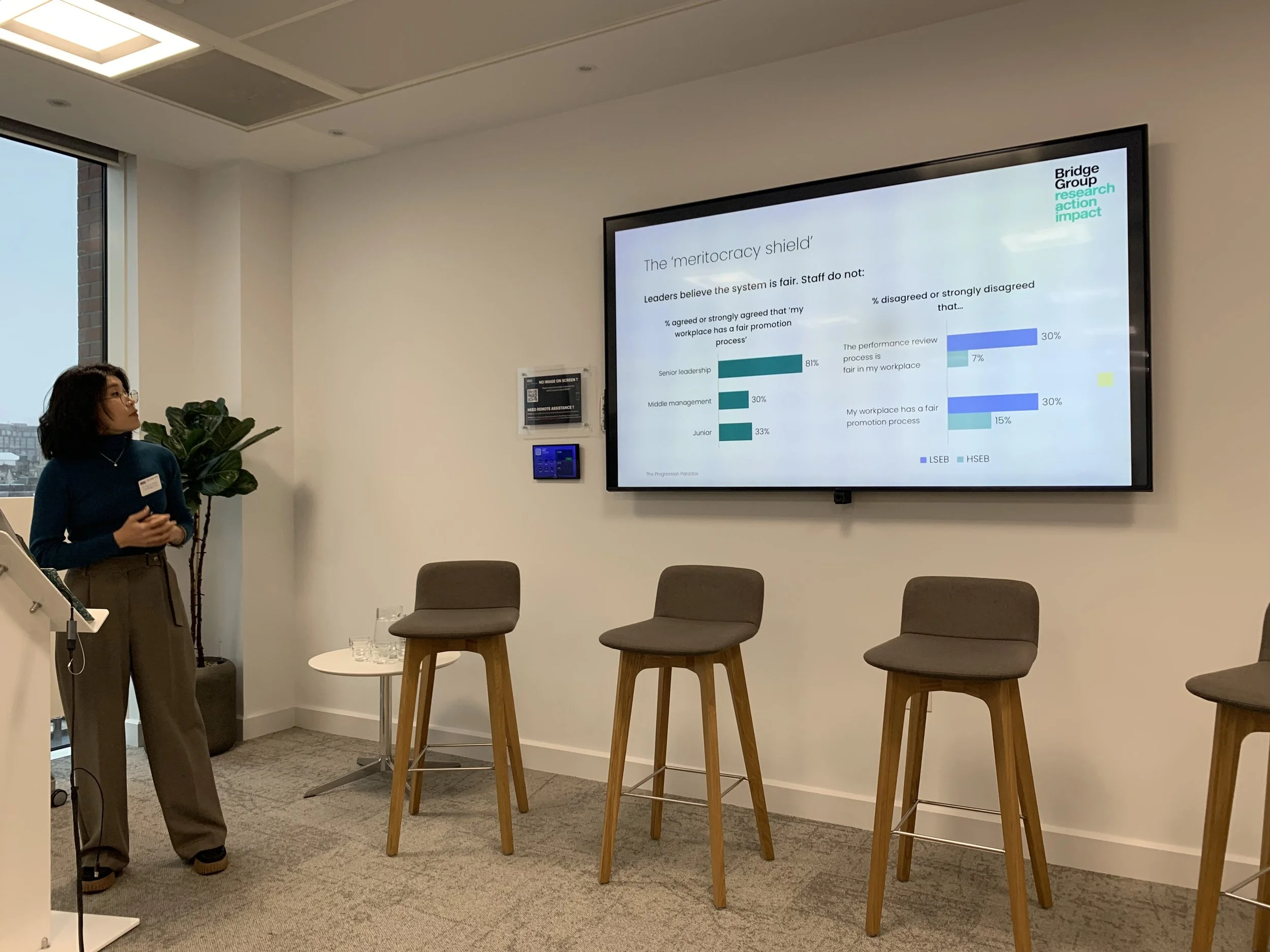
81% of senior leaders think promotion processes are fair, compared with just 30% of middle managers, a new report has found.
The findings from charitable organisation, Access Accountancy in partnership with the Bridge Group, explores what lies behind that difference, setting out practical steps accountancy organisations can take to make progression fairer.
The report also highlights how experiences diverge across socio-economic backgrounds. 58% of respondents from lower socio-economic backgrounds say they have to work harder than their peers to prove they belong, compared with 24% from higher socio-economic backgrounds. Almost half (48%) say they change their accent, mannerisms or topics of conversation to fit in around senior colleagues, compared with 27% of their higher socio-economic background peers.
The findings build on research conducted by the Bridge Group on behalf of Access Accountancy in 2023, which found that professionals from lower socio-economic backgrounds reached their first promotion in an average of 1.7 years, compared with 2.1 years for their peers. This changed as they moved further up the career ladder and they subsequently took an average of 4.4 years to reach middle management, compared with 3.6 years, and 7.1 years to reach senior leadership, compared with 6.1 years.
This year’s report, The Progression Paradox, explores why that socio-economic progression gap emerges, pointing to the growing importance of factors such as visibility, sponsorship, professional networks and access to career-enhancing opportunities as people move into more senior roles. It suggests that assumptions that existing processes are meritocratic can make structural barriers harder to recognise, even where organisations are committed to fairness.
Mark Pavlides, Chair of Access Accountancy, said:
“For many young people entering the accountancy profession there can be a perception that the progression pathway is clear. The challenge comes later, when the lived experience of that progression depends more heavily on visibility, sponsorship and networks. If we want a profession that draws on talent from every background, we need to ensure those opportunities are accessible to everyone.
“It's encouraging that firms across the profession are already taking action in this area. However, these findings show that barriers to progression still exist for many people from lower socio-economic backgrounds, and that more needs to be done to address them.
“No one should feel their background limits how far they can go in their career. We’ll continue to work with our signatories to share good practice, learn from the data and help ensure talent and potential are what determine who progresses into leadership roles”
The report outlines six practical leadership actions applicable to both large firms and smaller practices, these include:
Share this research with your people, starting with the perception gap
Make progression by background a leadership measure, with a named owner
Use your data to find where progression stalls
Formalise how work is allocated
Turn mentoring into sponsorship
Write down what it takes to advance and reach each grade.
Jenny Baskerville, Chief Executive of the Bridge Group, added:
“The accountancy profession has invested heavily in widening entry routes but a sincere belief in fairness is not enough to fix what happens after people join. Senior leaders often operate behind a ‘meritocracy shield’. Assuming the system works because it worked for them, even while middle managers and lower socio-economic talent see a very different reality.
“Our research shows that talent is not stalling from a lack of capability but because objective milestones give way to informal networks and unwritten rules. Closing this gap requires leaders to use the levers they already control. We have tailored these actions so they work across organisations of different sizes – whether that is a smaller practice understanding how key client assignments are handed out or a large firm reviewing its resourcing and progression data. By shifting from mentoring to active sponsorship and creating clear, transparent paths to senior roles, employers can ensure talent from every background has the opportunity to progress into leadership.”
About Access Accountancy
Access Accountancy is a collaboration of more than 30 organisations and professional bodies dedicated to improving access to, and progression within, the accountancy profession in the UK. Their vision is for the accountancy profession to be more representative of the socio-economic demographic of wider society.
The following organisations are signed up: AAT, AIA, BDO, Blick Rothenberg, BPP, Cafcass, CIPFA, Clive Owen, Crowe, Deloitte, Duncan & Toplis, EY, First Intuition, Forvis Mazars, Grant Thornton, HaysMac, ICAEW, ICAS, Kaplan, KPMG, Kreston Reeves, Menzies, MHA, Moore Kingston Smith, National Audit Office, NHS Finance in England, Price Bailey, PwC, Rayner Essex, RSM, S&W, Saffery and UHY.
Members work together to improve access to and progression within the accountancy profession. This includes widening access to opportunities, using socio-economic data to identify barriers, sharing good practice and supporting action to make recruitment, retention and progression fairer.