
New report with Progress Together: The Power of Progression
New report with Progress Together: The Power of Progression
Creating regional jobs is not enough: 61% of senior financial services roles remain in London, new research finds
18 November 2026
Creating financial services jobs outside London is not enough to deliver meaningful regional growth if employees cannot progress into leadership, Progress Together (the financial services membership body working to break the class ceiling) warns. Its latest report in collaboration with the Bridge Group, The Power of Progression: Unlocking Progression and Growth Across UK Financial Services, reveals that 82% of junior roles are outside London, yet 61% of senior positions are concentrated in the capital.
Launched at Mansion House, the report analyses data from 263,958 employees across 38 financial services firms, alongside exploratory studies of performance and retention and supporting research from EY. With financial services contributing around 8% of UK economic output, Progress Together is calling on Government and employers to measure regional growth not just by jobs created, but by careers developed, talent retained and future leaders produced.
Regional jobs must lead to regional careers
Senior positions account for 17% of financial services roles in London, compared with just 7% elsewhere in the UK. Outside the capital, representation of employees from lower socio-economic backgrounds falls from 36% in junior roles to 29% in senior positions.
The findings raise questions about whether regional financial services growth is creating lasting career opportunities. Progress Together argues that regional success must also be measured by access to development, progression and leadership, enabling talented employees to build successful careers without relocating to London.
Andrew Bailey, Governor of the Bank of England, said:
"The success of the financial services industry relies on the quality of its people, so investing in talent isn't a nice-to-have, it's essential. Better decisions come from bringing together people with different skills, experiences and perspectives, and making sure the best people can progress, whatever their background."
Bronek Masojada, Lord Mayor of the City of London, said:
“The UK's financial services sector draws its strength from talent across the country. Creating regional jobs is important, but our regional financial centres must also be places where talent can develop and future leaders can emerge. This will strengthen these financial centres and the UK's competitiveness.”
Slower progression could be costing firms valuable talent
Employees from lower socio-economic backgrounds take an average of 7.5 years to progress from middle to senior roles, compared with 6.3 years for more advantaged colleagues.
Yet an exploratory study across five firms found no consistent evidence of poorer performance ratings among employees from less advantaged backgrounds.
A separate analysis of 20,700 current and former employees across six firms found that those who had progressed were around four times less likely to leave their organisation. Although this does not establish causation, it highlights a potential link between progression and retention.
Supporting research from EY identifies potential commercial risks of socio-economic exclusion, including avoidable turnover costs, weaker decision-making and missed business opportunities.
Jenny Baskerville, Chief Executive of the Bridge Group, said:
“This research shifts the conversation from who enters financial services to whether talent has an equal opportunity to progress and lead once inside. Our pilot analysis points to progression, rather than performance ratings, as a key bottleneck and when progression stalls, valuable talent leaves. By showing us where pathways narrow regionally and across career stages, this data provides the sector with an essential foundation for targeted action.”
Vincent Keaveny CBE, Chair of Progress Together and former Lord Mayor of the City of London, said:
“When talented employees from less advantaged backgrounds take longer to progress, despite no consistent evidence of poorer performance, firms must ask what is holding them back.
"This is not just about fairness. Overlooking talent carries a business cost. As the sector competes for future-critical skills, better progression is essential to retaining talent and strengthening UK competitiveness.”
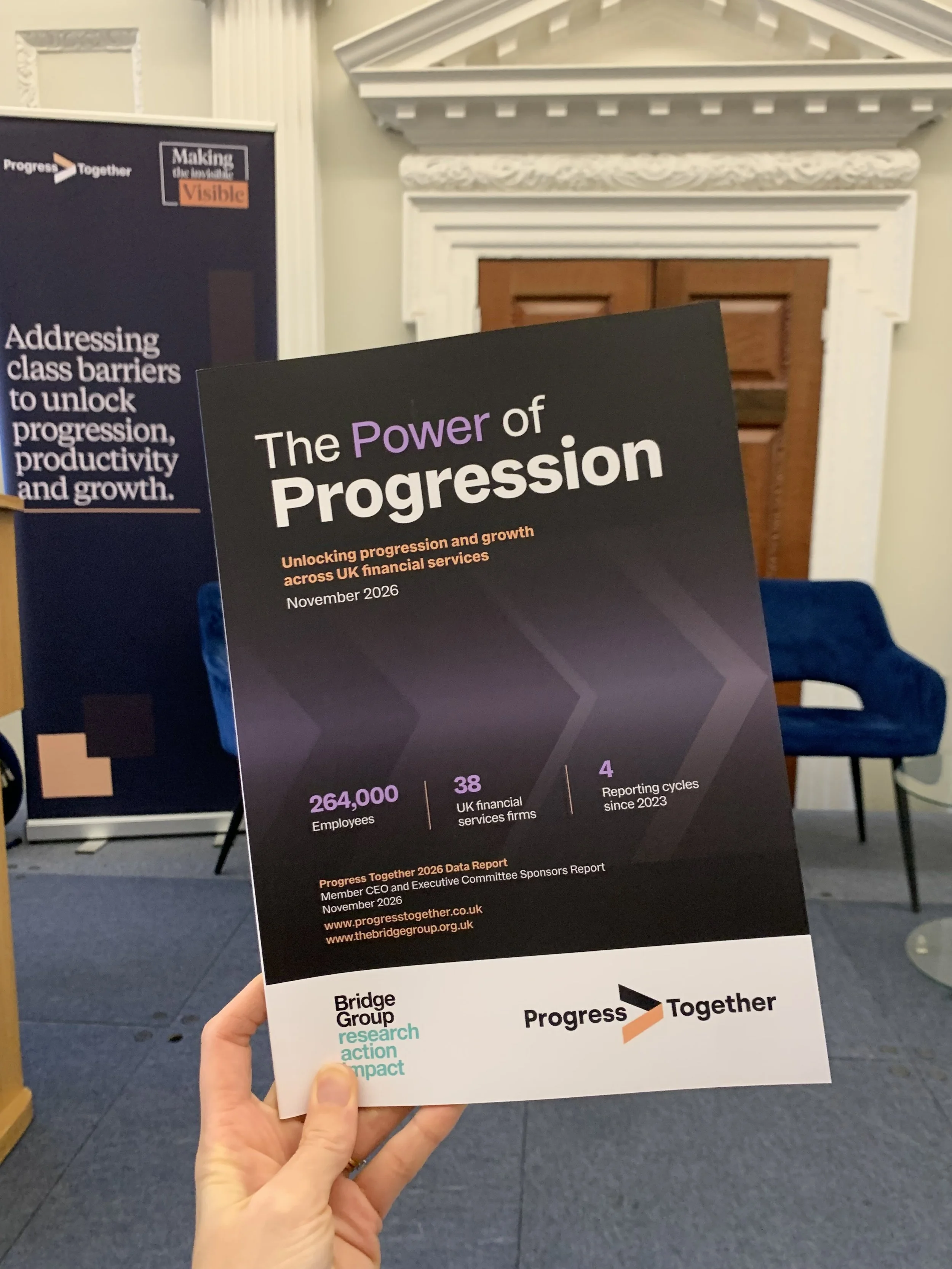
About the report
The Power of Progression: Unlocking Progression and Growth Across UK Financial Services is Progress Together's 2026 data report, produced in collaboration with the Bridge Group, with supporting business-case research from EY.
Methodology
The report analyses anonymised workforce data from 263,958 employees across 38 participating UK financial services firms, examining socio-economic representation, career progression and leadership across regions.
Two smaller exploratory studies examined:
Performance: Appraisal data from 6,776 employees across five firms found no consistent evidence of poorer performance ratings among employees from lower socio-economic backgrounds after accounting for role, tenure, gender and ethnicity.
Retention: Data from 20,700 current and former employees across six firms identified an association between career progression and lower attrition.
These studies are preliminary and should not be treated as representative of the entire sector. The retention findings establish association, not causation.
EY's supporting research examines the potential commercial implications of socio-economic inclusion, including retention, decision-making and competitiveness.
About Progress Together
Progress Together is a not-for-profit membership body working to break the class ceiling in UK financial services, ensuring talent and performance, rather than socio-economic background, determine career progression.